Health records are accessible, but health history is fragmented.

MediSync — From scattered health records to a connected health story.
MediSync is a mobile health-record experience designed to help people make sense of fragmented medical information. Prescriptions, lab reports, doctor visits, and medication changes often exist across different sources, making it difficult to understand how they connect over time.
Instead of designing another place to simply store documents, I explored how a product could help users reconstruct their health history through context, chronology, and evidence.
The solution centers on an event-based health timeline that connects related records while keeping the original evidence accessible. AI assists with extracting and organizing information, but users remain responsible for reviewing and confirming what gets saved.
Connect
Scattered records → one timeline
UNDERSTAND
Documents → meaningful context
VERIFY
AI assistance → user control
Prescriptions, lab reports, doctor visits, and medication information are often spread across WhatsApp, email, hospital apps, cloud storage, and physical files. While users may be able to find individual records, they struggle to understand how those records connect over time, what changed, and which information is relevant when they need it.
This forces users to search across sources, compare documents, and rely on memory to reconstruct their health story—especially when preparing for a doctor appointment.
The core problem
People don't just need a place to store their health records. They need help turning scattered records into meaningful health context.
Understanding the real problem
I started by exploring how people currently find, manage, and make sense of their health records across different sources. The research was synthetic: I built the personas myself and interviewed them one by one with AI, so these are hypotheses to validate, not findings from real participants.
The research focused on three questions:
Where do health records live today?
How do people reconstruct their health history?
What makes them trust or question organized health information?
SCATTERED
Records live everywhere.
CONTEXT
Users struggle to connect the story.
TRUST
AI needs verification and evidence.
Research signals
01 — Records are scattered
Health information can exist across email, WhatsApp, cloud storage, hospital apps, and physical files.
02 — Chronology matters
Users think in terms of visits, tests, prescriptions, and changes—not isolated documents.
03 — Relevance is uncertain
When users don't know what matters for an appointment, they tend to collect more information than necessary.
04 — Trust requires control
Automated organization needs to be reviewable, correctable, and traceable back to the original evidence.
05 — Memory fills the gaps
Users often rely on memory to connect information that isn't explicitly connected across records.

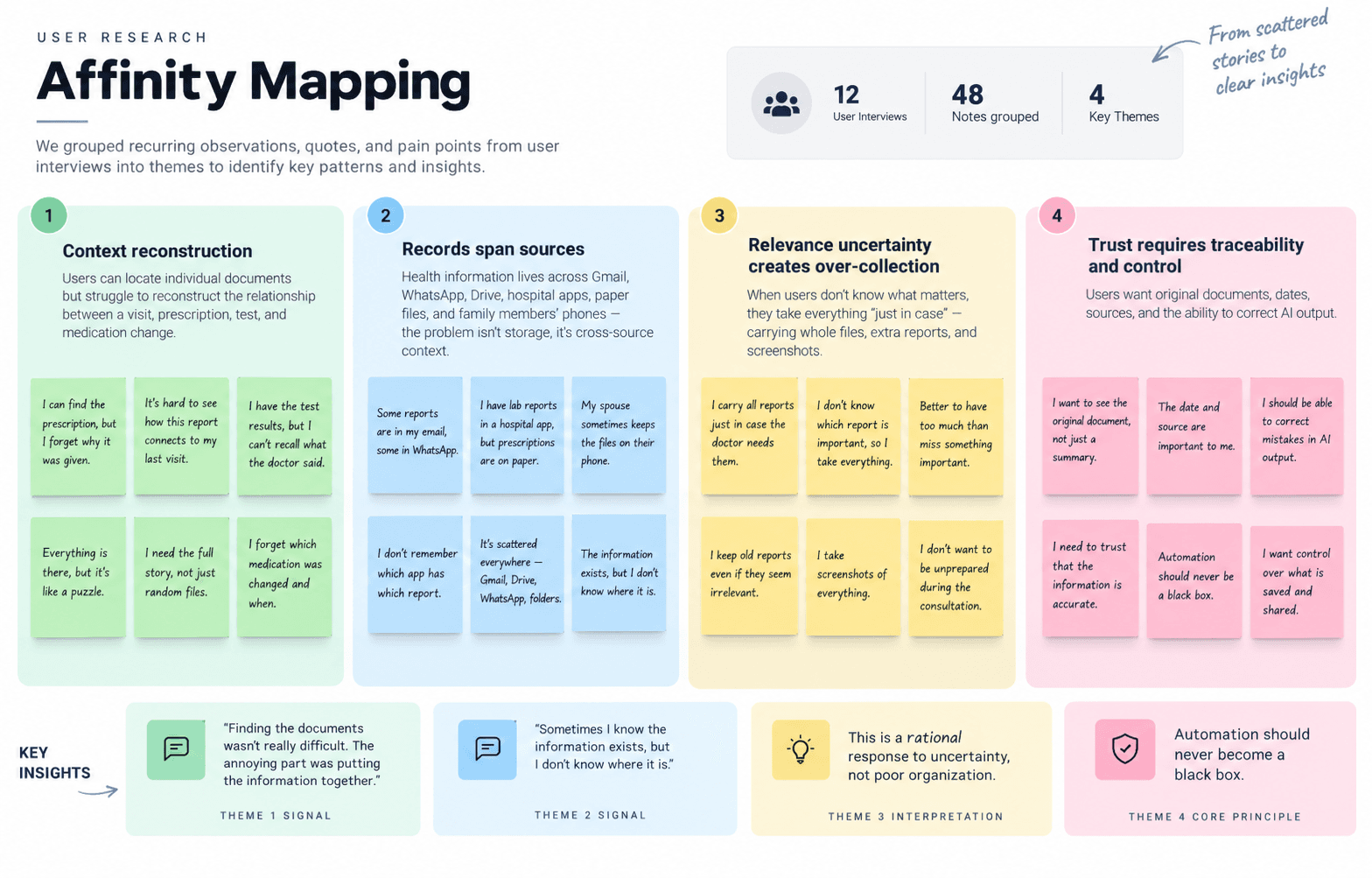
I grouped recurring observations from the research to identify the underlying behaviors and needs rather than designing around individual complaints.
The synthesis revealed three dominant themes:
01 — CONTEXT
Users struggle to connect prescriptions, reports, visits, and medication changes into one coherent story.
02 — CHRONOLOGY
Understanding what happened when is essential, especially when users need to explain changes over time.
03 — RELEVANCE
Users don't necessarily need every record at once—they need to know which information matters for the situation at hand.
Turning scattered records into useful health context
MediSync's core flow is designed around a simple progression:
Capture → Verify → Connect → Understand → Prepare

Key design decision: the information architecture is built around health events rather than individual documents, giving the core model Timeline → Health Event → Relevant Context → Original Evidence.
I translated the structure into a calm, trustworthy healthcare interface using clear hierarchy, accessible typography, and a focused visual system.
01 — TRUST
Clean healthcare aesthetic with a confident blue-led palette.
02 — CLARITY
Strong hierarchy makes complex health information easier to scan.
03 — CONSISTENCY
Reusable components and design tokens create a cohesive experience across screens.

I turned the high-fidelity designs into an interactive prototype and walked through the core flows myself to check navigation, information hierarchy, AI verification, and how clearly health context comes across.
01 — PROTOTYPE
Connected the key flows from record capture to verification, timeline exploration, and appointment preparation.
02 — WALKTHROUGH
Checked where a user might hesitate, misread an action, or need more context.
03 — ITERATE
Refined navigation, hierarchy, verification cues, and source visibility based on the walkthrough.
Key takeaway
The goal wasn't just to make the screens work—it was to make the health story easier to understand and trust.
Walking through the prototype showed where the design needed clearer hierarchy, stronger navigation cues, and more confidence around AI-generated information.
01 — CLARIFY
Strengthened labels, hierarchy, and primary actions to reduce hesitation.
02 — GUIDE
Improved navigation between health events, related records, and original evidence.
03 — BUILD TRUST
Made AI-extracted information easier to review, edit, and verify before saving.
Design principle
Every iteration aimed to make the experience easier to understand without hiding complexity or removing user control.
A health timeline built around context
MediSync brings the core experience together into one connected system: users can capture records, understand how they relate, and prepare for conversations with their doctor.
01 — HEALTH TIMELINE
A chronological view turns individual records into a connected health history.02 — EVENT CONTEXT
Related prescriptions, reports, and medication changes are grouped around meaningful health events.03 — APPOINTMENT PREP
Relevant history is surfaced into a focused appointment view, helping users prepare without searching through every record.04 — EVIDENCE-BASED AI
AI reduces the effort of organizing records, while verification and original evidence keep the user in control.Closing statement
MediSync doesn't just collect health records. It helps people understand what happened, what changed, and what matters next.


LESS SEARCHING
Bring scattered records into a chronological health timeline.
LESS RECONSTRUCTION
Connect visits, prescriptions, reports, and medication changes through health events.
MORE CONFIDENCE
Keep AI-assisted organization reviewable, with original evidence available for verification.
Storage isn't the same as understanding
A product can bring records into one place and still leave users with the same problem. Context and relationships matter as much as access.
Design around behavior, not demographics
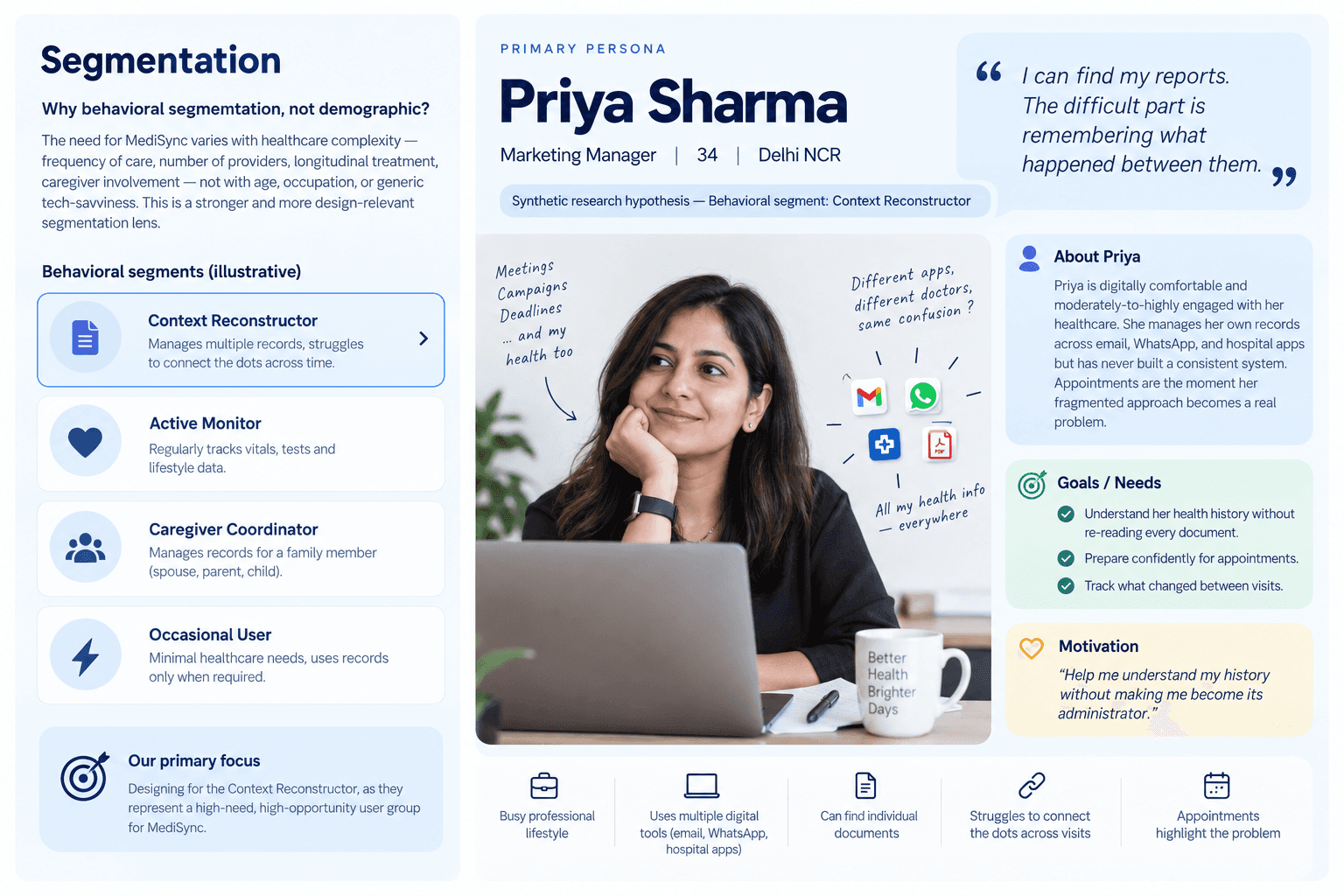
The strongest opportunity emerged from identifying Context Reconstructors—users who struggle to connect health events over time.
AI needs boundaries
In healthcare, automation should reduce organizational effort without taking away user control. AI extracts → user verifies → system saves.
Evidence builds trust
Showing the relationship between an organized health event and its original source makes the experience more transparent and verifiable.
Good UX reduces cognitive work
The goal isn't to show users more information. It's to help them understand what happened, what changed, and what matters now.
MediSync's next phase would focus on moving from a concept toward a more robust, real-world product.
REAL USER VALIDATION
Test the experience with actual patients and caregivers to validate the research hypotheses and identify unmet needs.
BROADER RECORD CAPTURE
Explore integrations with email, WhatsApp, hospital portals, and other sources to reduce manual record collection.
AI RELIABILITY
Test extraction accuracy across different document formats and improve confidence states, corrections, and error handling.
CAREGIVER & SHARING FLOWS
Explore controlled ways for users to share relevant health context with family members or healthcare professionals.